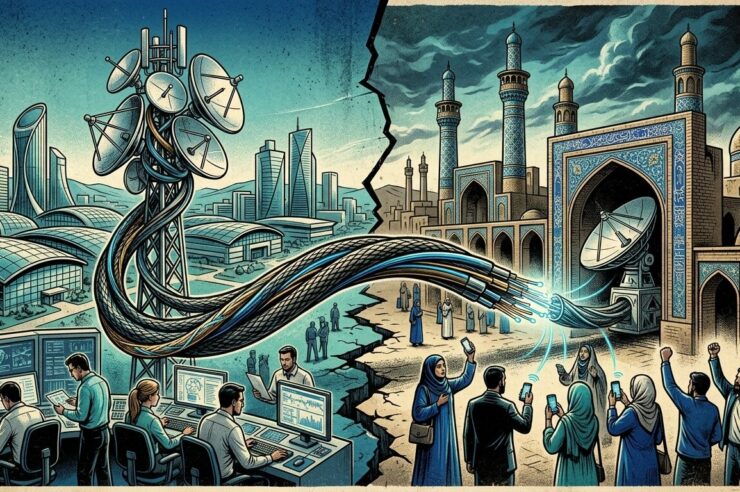
When 22-year-old Mahsa Amini died in morality police custody in September 2022, the footage of the resulting protests did not stay local. Within hours, videos circulated on Instagram, Twitter, and TikTok. Millions of people in the United States and Europe watched these events unfold in real time. The Iranian government moved quickly to block these platforms. However, the videos kept coming through VPNs and encrypted apps. These are the very tools that companies in Silicon Valley and Iran’s digital activists now rely upon for communication.
That dynamic—a government trying to silence its people against a global tech infrastructure—is now central to political conflict. The platforms and policy decisions made in San Francisco and Cupertino have direct consequences in Tehran. Consequently, the companies making those decisions often face responsibilities they never anticipated. This piece examines exactly how global tech platforms shape the protest movement today. Specifically, we look at what they enable, what they block, and what their role means for the future of digital freedom.
The Platforms That Became Protest Infrastructure
Instagram has become the most important social platform in Iran. This occurred partly because the government’s attempt to block it during the 2022 protests backfired. As a result, the shutdown drew international attention and accelerated VPN adoption among ordinary citizens. Meta, the parent company of Instagram, found itself at the center of a geopolitical crisis. Furthermore, the company was not originally structured to handle such a high-stakes scenario.
Signal has also become the communication tool of choice for activists. Its end-to-end encryption makes it significantly harder for state surveillance systems to intercept messages. Similarly, WhatsApp serves a vital function for broader community communication. Nevertheless, its metadata remains visible to network-level surveillance.
Perhaps the most unexpected entrant is Starlink, operated by SpaceX. During total internet shutdowns, Starlink terminals allow activists to maintain outside connections. Because these terminals are smuggled in at great risk, their reach remains limited. However, their presence proves that the link between Silicon Valley and Iran is becoming harder for any single government to break.
The Sanctions Problem: When US Law Hurts Activists
There is a painful irony at the heart of the relationship between Silicon Valley and Iran. US sanctions designed to pressure the government often block ordinary Iranians from the tools they need. For years, app stores removed Iranian developers’ apps, and cloud services cut off users. Consequently, activists found it impossible to pay for secure communication tools or VPN subscriptions.
The US Treasury Department has issued licenses to carve out exceptions for personal software. Yet, implementation remains inconsistent and confusing for tech firms. Many companies chose the safest path by blocking all Iranian users instead of navigating legal nuances. For a closer look at how intelligence operations shape these decisions, see our piece on Inside Intelligence Work with the Bustamantes.
In fact, American sanctions policy has at times done more harm to civil society than to the targeted government. According to documentation by digital rights organizations like Access Now, this is a systemic failure at the intersection of foreign policy and corporate compliance. Therefore, it deserves far more public attention than it currently receives.
What the Platforms Get Right — And Where They Fall Short
To be fair, some tech companies have taken meaningful action. After the 2022 protests, Google accelerated the rollout of its VPN service in the region. Additionally, Apple and Google both allowed VPN apps to remain available longer than usual despite government pressure. Meta even established a dedicated crisis response team to handle content moderation.
But significant gaps remain. Data from Freedom House indicates that Iran remains one of the most restricted environments for internet freedom. Algorithms trained on English content frequently misidentify Farsi protest material as violating guidelines. As a result, documentation of human rights abuses is sometimes removed by mistake.
Three Ways Tech Is Shifting the Balance
Despite these complications, technology has changed the calculus for protest movements. Specifically, it has shifted the balance in three ways:
- Documentation at Scale: Smartphone video makes it harder to deny state violence.
- Diaspora Coordination: Millions in the global diaspora coordinate in real time with those inside the country.
- Circumvention Tools: The widespread use of Tor and encrypted messaging raises the cost of information blackouts.
The Responsibility Question: What Should Companies Do?
The broader question is whether companies in Silicon Valley and Iran’s activists share a formal obligation. Most firms are reluctant to answer this directly. Some advocates argue for a “digital Geneva Convention” to protect civilian access during crises. In contrast, others believe the real leverage lies in tightening export controls on surveillance tech.
What is clear is that the current improvisation approach is inadequate. The stakes for those depending on these platforms are simply too high. Ultimately, the activists who continue to show up are a testament to the human spirit. If you’re curious about what drives that resilience, see our piece on The Science Behind Persistence and Positivity.
Conclusion
Silicon Valley did not set out to be a front line in a struggle for political freedom. Nevertheless, that is exactly where it finds itself today. The tools and policy choices made by a handful of California companies now shape the lives of millions. In the end, while the digital tools provide the medium, the courage of the Iranian people provides the message. Whether the tech industry rises to meet this responsibility will define what these companies truly stand for beyond their mission statements.